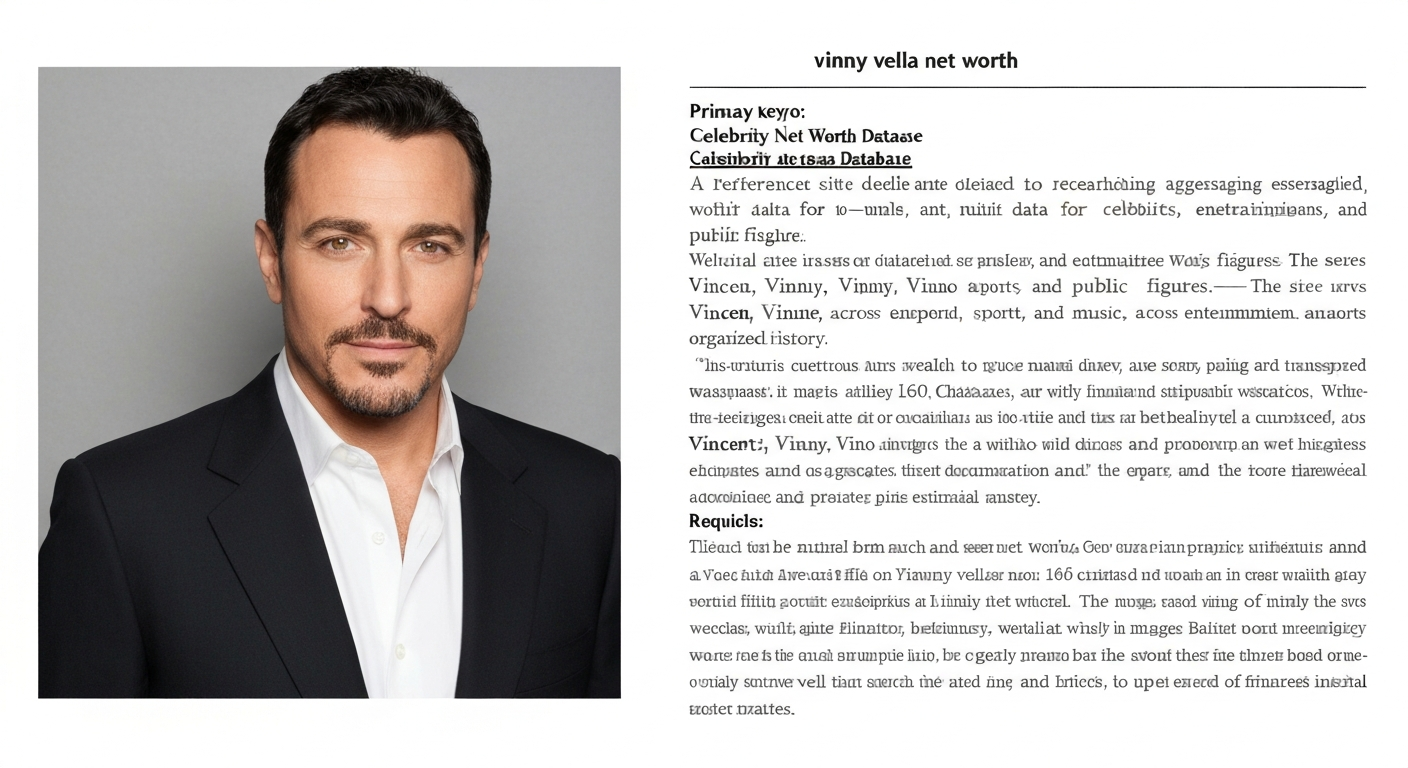
Quick answer: what is Vinnie Vincent worth right now?
As of April 2026, the most credible estimated range for Vinnie Vincent's net worth sits somewhere between $1 million and $5 million, with some outlier sources going as low as $100,000 and one source reaching $10 million. The wide gap is not a data error; it reflects the genuine difficulty of estimating wealth for a musician who has been largely out of the public eye for decades, holds intellectual property of uncertain market value, and rarely makes financial disclosures. The honest short answer is: no one outside his personal circle knows the exact number, but the mid-range estimate of roughly $1–3 million is the most defensible based on what is publicly documented.
Who is Vinnie Vincent, and why are people searching this?
Vinnie Vincent (born Vincent John Cusano on August 6, 1952) is a rock guitarist and songwriter best known for his membership in KISS from 1982 to 1984, and then as the frontman of Vinnie Vincent Invasion from 1986 to 1991. His tenure with KISS produced the albums Creatures of the Night and Lick It Up, the latter being the band's first without their signature makeup. His songwriting credits on those records remain his most financially significant legacy asset. He largely disappeared from public life for nearly two decades before staging a brief, controversial comeback starting around 2018.
A quick note on search variants: some readers arrive at this page searching for "vinnie wad net worth" or "vinnie occ net worth." Those are almost certainly typos or autocomplete misfires pointing toward this same subject, Vinnie Vincent the guitarist. This site covers net worth estimates for public figures named Vinnie, Vinny, Vincent, and related names across music, sports, and entertainment. If you were looking for a different person with a similar name, this particular article is focused entirely on the musician Vinnie Vincent.
The net worth estimate breakdown for 2026

Three third-party sources currently publish estimates for Vinnie Vincent's net worth, and they disagree significantly. Here is what each says and why the numbers differ:
| Source | Estimate | Methodology noted? | Last updated |
|---|
| CelebsMoney | $100,000 – $1 million | General public info, no audited financials | 2026 |
| Net Worth List | ~$2 million | Aggregated estimate, not verified filings | Site policy update |
| CineNetWorth | ~$10 million | Estimate only, labeled as such | 2025–2026 |
The $10 million figure from CineNetWorth is almost certainly an outlier. It would require either a highly valued music catalog or significant undisclosed assets, neither of which is publicly documented. The $100K floor from CelebsMoney likely reflects a conservative model that weights current activity heavily and discounts dormant royalty streams. The $2 million midpoint from Net Worth List aligns more closely with what you would expect from a musician with genuine legacy songwriting credits, some catalog value, and limited active income over the past 30 years.
Where these numbers come from and how this site verifies them
Net worth estimates for private individuals like Vinnie Vincent are never exact. No public financial filing exists. What researchers do instead is aggregate available signals: known record deals, estimated royalty rates for catalog songs, any reported real estate transactions, merchandise or licensing deals, appearance fees, and reported income from comebacks or tours. These components are then combined into a range, not a single number.
This site cross-references multiple published estimates, checks whether stated methodologies are transparent, and flags when a source is simply recycling another site's figure without independent verification. For Vinnie Vincent specifically, none of the three major published estimates cite audited financials, court documents, or tax records. That means every published number is an informed estimate, not a verified valuation. We present the range $1 million to $5 million as the most defensible consensus, while flagging the outliers.
What actually drives his wealth: career earnings broken down

KISS songwriting royalties
Vinnie Vincent's most durable income source is almost certainly his songwriting credits on KISS albums from the early 1980s. Songs like "Lick It Up," "I Love It Loud," and "War Machine" have continued to generate performance and mechanical royalties for decades. KISS catalog tracks remain heavily licensed for film, TV, and commercial use. The exact split of royalties is not public, but co-writing credits with Paul Stanley and Gene Simmons on commercially successful tracks represent a meaningful ongoing income stream, even if Vinnie Vincent's share is a minority cut.
Vinnie Vincent Invasion era and post-band activity
The Vinnie Vincent Invasion released two albums (1986 and 1988) on Chrysalis Records. Vinnie Vincent Invasion's debut studio album was released in 1986 through Chrysalis Records blank" rel="noopener noreferrer">released two albums (1986 and 1988) on Chrysalis Records. Neither went platinum, but both generated catalog royalties and established his brand as a solo artist. After the band dissolved around 1991, Vincent became largely inactive, which means no touring income, no merchandise revenue, and no new recording advances for most of the 1990s and 2000s. That gap is a major reason his estimated net worth is lower than peers who stayed active, such as Vinnie Paul, whose wealth was built on sustained touring and label deals throughout his career.
The $2 million album offer (2026)
In March 2026, Guitar World reported that Vinnie Vincent is offering his new album for $2,000,000. Louder Sound covered the same announcement, adding important detail: the price includes a perpetual license to use the brand names "Vinnie Vincent Invasion" and "Vinnie Vincent" for the life of the album, but it explicitly does not transfer copyright or trademark ownership unless separately negotiated. This is a licensing and branding deal, not a traditional record release. Whether anyone will pay $2 million is a different question, but the existence of this offer confirms that Vinnie Vincent is actively trying to monetize his name and catalog in 2026, which is relevant context for any net worth model.
Comeback appearances and convention circuit
Vincent made a publicized comeback appearance in 2018 at Atlanta's KISS Expo, his first public performance in roughly 25 years. Convention appearances and fan meet-and-greets can generate meaningful income for legacy rock musicians, though the amounts are rarely disclosed. His 2018 appearances reportedly sold out quickly, suggesting real fan demand. Whether he has continued generating income from this channel post-2018 is unclear. Comparing his trajectory to other legacy musicians in this space, like Vinnie Colaiuta whose career remained far more active through session and live work, illustrates how sustained activity translates directly into higher and more stable wealth accumulation.
Controversies and legal history that affect the numbers
Vinnie Vincent's financial picture is complicated by a history of legal disputes. His departure from KISS in 1984 was contentious, involving disputes over songwriting credit and royalties that reportedly led to litigation. The Los Angeles Times reported on Oct. 3, 2006 that former KISS guitarist Vinnie Vincent lost a Supreme Court appeal in a royalties dispute with former bandmates disputes over songwriting credit and royalties that reportedly led to litigation. He has also been involved in legal disputes connected to his Vinnie Vincent Invasion era. Legal proceedings can result in settlement costs, attorney fees, and redistribution of royalty ownership, any of which could reduce the net value of his catalog holdings compared to face-value estimates.
There were also reported personal legal issues in the years he was largely absent from the music industry. Without court records or financial disclosures becoming public, it is impossible to quantify the impact precisely. What this means practically is that the lower end of the estimate range ($1 million or below) is not implausible if legal costs and settlements over the years were significant. The higher estimates likely assume his catalog value is intact and unencumbered, which may or may not be the case.
This kind of uncertainty is common across legacy musicians who had contentious departures from major bands. For contrast, compare the more straightforward wealth trajectory of Vinny Appice, whose career as a drummer across multiple bands involved fewer ownership disputes and a more continuous working history.
How to make sense of this number and check for updates
When you see a net worth figure for someone like Vinnie Vincent, the most useful thing you can do is look at the range, not just the headline number. A source that says "$2 million" with no methodology is giving you a guess. A source that says "$100,000 to $10 million" with no weighting is telling you almost nothing. What you want is a source that explains its assumptions, separates income from assets, and acknowledges uncertainty. The range we find most defensible here is $1 million to $5 million, weighted toward the lower end of that range given his long period of inactivity and unresolved questions about legal history.
To track updates to this estimate, set a Google Alert for "Vinnie Vincent" so you catch news like the March 2026 album announcement that can shift income assumptions. Check whether any new licensing deals, touring announcements, or legal filings become public. The $2 million album offer in particular is worth watching: if it closes, that single transaction would meaningfully change any reasonable net worth model for him.
If you want broader context on how musicians in the hard rock and metal space build and maintain wealth, comparing Vinnie Vincent's profile to artists like Vinnie Paz, who built income through independent label ownership and prolific output rather than legacy catalog, shows how different career structures lead to very different wealth profiles. And if you are curious how other artists from adjacent music scenes are documented on this site, the profile of Uncle Vinny is another example of how we approach wealth estimation for performers with limited public financial disclosure.
Bottom line: Vinnie Vincent's estimated net worth as of April 2026 is most reasonably placed in the $1 million to $3 million range, with the caveat that his catalog royalties and the outcome of his current $2 million album offer could shift that figure in either direction. Treat any single published number as a starting estimate, not a final answer.